
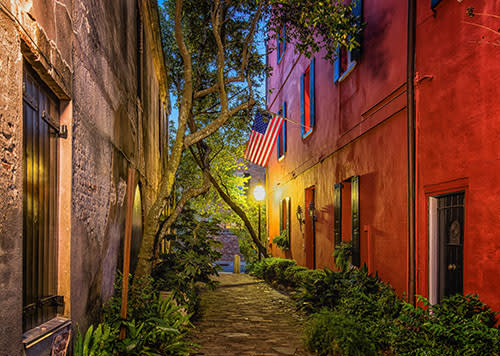
Since enacting America's first municipal historic preservation ordinance in 1931, Historic Downtown Charleston (29401 and 29403) has protected the architectural scarcity that drives $2M to $18M+ single-house and carriage-compound valuations. Yet buyers and out-of-area advisors routinely misprice historic renovations by confusing Board of Architectural Review (BAR) streetscape rules with perpetual Historic Charleston Foundation easements—or assuming local tax freezes exist where they were never enacted.
1. BAR-Small vs. BAR-Large: The 10,000-Square-Foot Threshold & Right-of-Way Rule
- BAR-Small (BAR-S) vs. BAR-Large (BAR-L): Projects totaling 10,000 square feet or less go before BAR-Small (meeting the second and fourth Thursdays monthly), while renovations or new construction exceeding 10,000 square feet require full BAR-Large public hearings (second Wednesdays), with multi-stage Conceptual, Preliminary, Final, and Staff review timelines that regularly add 60 to 180+ days before building permits issue.
- Public Right-of-Way Jurisdiction: Within the Old and Historic District and Old City District, the BAR regulates every exterior alteration, piazza restoration, slate or standing-seam metal roof, historic wood window sash, masonry repointing, and garden wall visible from a public street—while generally leaving interior floorplan reconfigurations outside BAR scope unless a private easement applies.
- Strict Demolition Bans Ignore Restoration Cost: The BAR reviews all demolitions regardless of age inside the Old and Historic District and all structures 50+ years old south of Mount Pleasant Street—and legally cannot weigh high restoration cost as grounds to approve demolition of a contributing historic structure.
2. Historic Charleston Foundation Easements & Carolopolis Award Provenance
- 400+ Perpetual Exterior, Interior & Open-Space Easements: Unlike BAR review—which stops at what can be seen from the public street—a perpetual preservation easement held by Historic Charleston Foundation (protecting over 400 Lowcountry properties) governs the entire parcel in perpetuity, including rear dependencies, courtyard subdivisions, archaeological deposits, mature trees, and—where an Interior Easement is recorded—historic mantels, heart-pine floors, staircases, and ornamental plasterwork.
- Carolopolis Award & Resilience Pedigree: Conferred more than 1,500 times by the Preservation Society of Charleston since 1953 across Exterior, Interior, Pro Merito (20+ year stewardship), New Construction, and climate Resilience categories, a bronze Carolopolis plaque signals BAR-vetted craftsmanship and commands measurable resale premiums South of Broad, in Harleston Village, Ansonborough, and Wraggborough.
3. The Downtown "Bailey Bill" Myth vs. South Carolina's 25% Historic Tax Credit
- Why the Bailey Bill Does Not Apply in the City of Charleston: Although South Carolina's Bailey Bill allows participating municipalities to freeze property tax assessments for up to 10 years after major historic rehabilitations, the City of Charleston never enacted the ordinance—meaning buyers modeling a 10-year municipal property tax freeze on a 29401 or 29403 gut renovation face an unpleasant post-closing reassessment surprise.
- Real Tax Alpha (25% SC Homeowner Credit, Federal Credits & SC Act 388): Savvy Peninsula buyers instead capture South Carolina's 25% State Historic Rehabilitation Homeowner Income Tax Credit (S.C. Code Section 12-6-3535, when qualified exterior and structural rehabilitation outlays exceed $15,000 within 36 months and SHPO Part 1 and Part 2 approvals are secured BEFORE work begins), combined 20% Federal plus 10% State credits on eligible income-producing assets, Federal charitable deductions on newly donated easements, and SC Act 388's 4% primary-residence assessment (eliminating 100% of school-operating millage versus the 6% second-home rate).
4. Seismic Tie-Rods, Rising Damp & Retaining $30K to $150K+ in Seller Equity
- Pre-Contract Structural & Moisture Audits: Historic Charleston masonry and timber-frame homes demand specialized inspections for soft lime-mortar repointing (never rigid Portland cement, which traps rising damp and spalls 19th-century brick), 1886-era earthquake bolts, active Formosan termite bonds, slate/copper flashing life, and DFE + 1-to-2-foot flood mechanical elevations.
- Pre-Market Easement Packaging & 0-DOM Silent Seller & Redfin Premier Representation : Historic sellers protect top-of-market pricing by assembling BAR CoA approvals, recorded HCF/PSC easement files, and structural/termite documentation upfront—while listing with Jayson Wingfield through 0-DOM Silent Seller private placement and Redfin Premier representation protects against 3%–5% stale-MLS price reductions ($120,000+ on a $4M single house or $360,000+ on a $12M South of Broad estate; brokerage commissions are not set by law and are fully negotiable).
Authored and represented by Jayson Wingfield, Principal Real Estate Agent (SC License #103961 · CTAR MLS #27886 · $130.7M+ Closed Volume), Brokered by Redfin Corporation (Redfin Premier · 677 King Street, 3rd Floor, Charleston, SC 29403 · Direct/Text: 843-588-8416). Equal Housing Opportunity. Ready for a confidential Historic District BAR, easement, or pre-listing valuation audit? Call or text 843-588-8416 or request a private consultation via our Contact page.